
At a glance
This was a zero-to-one AI platform built for a professional cycling team competing at the highest level. The team generated enormous performance data daily power, heart rate, recovery, biometrics, race terrain but the gap between that data and a useful coaching decision was slow and analyst-dependent. The project was to design the intelligence layer that closed that gap.
My role
As Product & Design Lead, I owned the full product thinking from discovery through to shipping the agent logic, the data architecture decisions, the phased release strategy, and the observability framework. This was not a design execution brief. It was a design leadership brief.
How the agent thinks
Every output the agent delivers includes a reasoning trace not buried in a tooltip, threaded into the primary content. That transparency is not a feature. It is the product. A coaching team will override an agent they don't understand. An agent they understand, they will collaborate with.
The agent's primary surface is a conversational interface not a dashboard. Coaches ask it questions in natural language and receive structured answers with visible reasoning. That choice was deliberate: a dashboard asks you to go looking for insight. A conversational agent brings the insight to you, at the moment you need it, in a form you can act on immediately.
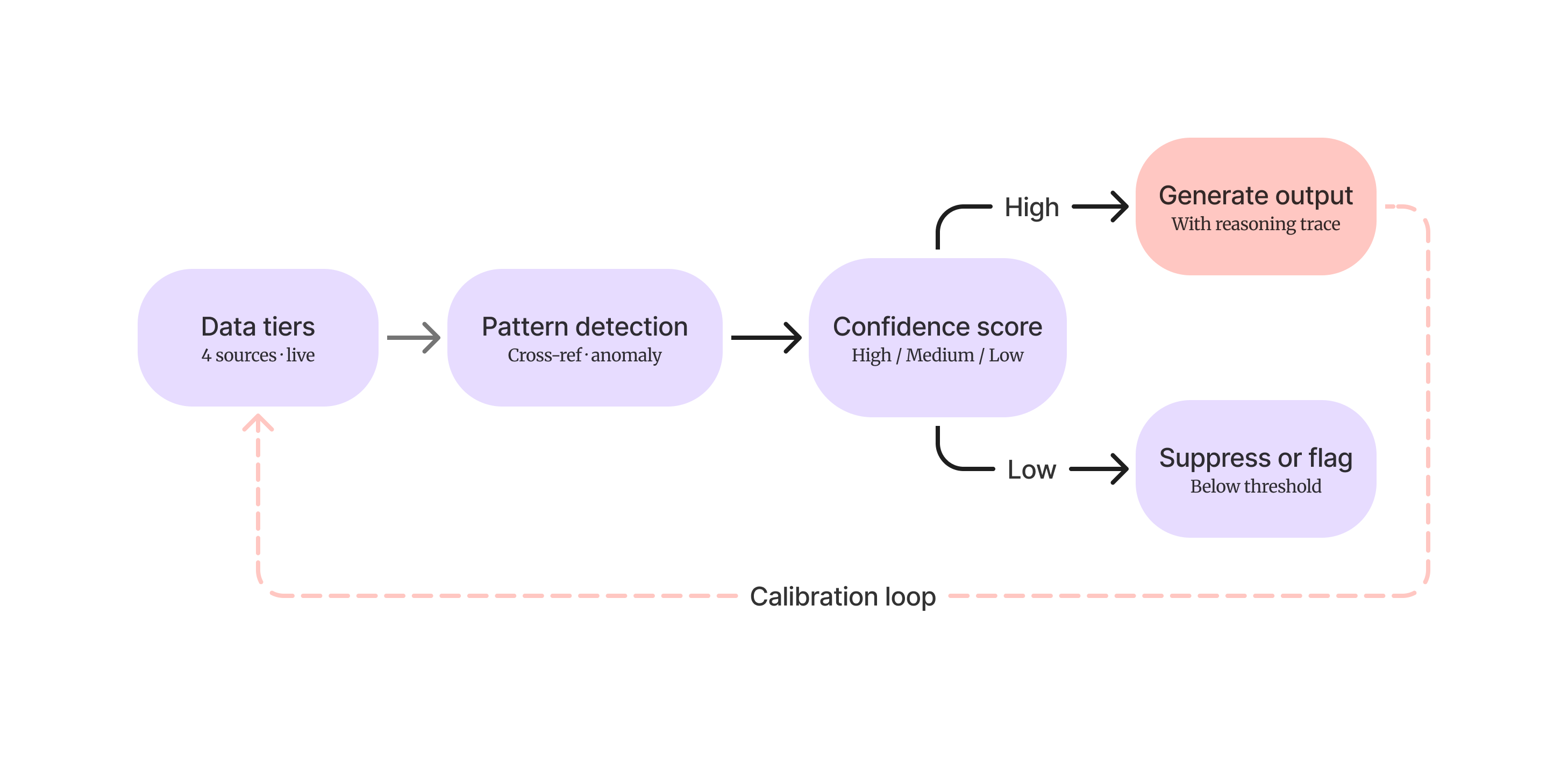
Agent decision flow, from data ingestion to output delivery, with calibration feeding back into the reasoning layer.
Other areas the full case study covers
Feel free to reach out for a walkthrough. I can go in depth on any of the following.
Discovery methodology
Five questions we answered before touching a design tool and why they shaped every decision after.
Data architecture
Four ingestion tiers with different freshness, trust levels, and failure modes. Why flat ingestion would have failed.
Phased release strategy
Shadow mode → supervised → proactive → full autonomy. Each phase gated by go/no-go criteria with the coaching team.
Early testing, three parallel tracks
Accuracy validation, experience testing, and edge-case stress all running before any output reached a coach.
Observability framework
Session depth, query classification, override rate, follow-through signal and a consent-based conversation review protocol.
Key design decisions
What we chose, what we rejected, and why in a format that makes the product thinking visible.
Mustafa JawharyProduct & Strategy Designer
At a glance
This was a zero-to-one AI platform built for a professional cycling team competing at the highest level. The team generated enormous performance data daily power, heart rate, recovery, biometrics, race terrain but the gap between that data and a useful coaching decision was slow and analyst-dependent. The project was to design the intelligence layer that closed that gap.
My role
As Product & Design Lead, I owned the full product thinking from discovery through to shipping the agent logic, the data architecture decisions, the phased release strategy, and the observability framework. This was not a design execution brief. It was a design leadership brief.
How the agent thinks
Every output the agent delivers includes a reasoning trace — not buried in a tooltip, threaded into the primary content. That transparency is not a feature. It is the product. A coaching team will override an agent they don't understand. An agent they understand, they will collaborate with.
The agent's primary surface is a conversational interface — not a dashboard. Coaches ask it questions in natural language and receive structured answers with visible reasoning. That choice was deliberate: a dashboard asks you to go looking for insight. A conversational agent brings the insight to you, at the moment you need it, in a form you can act on immediately.
Agent decision flow, from data ingestion to output delivery, with calibration feeding back into the reasoning layer.
Other areas the full case study covers
Feel free to reach out for a walkthrough. I can go in depth on any of the following.
Discovery methodology
Five questions we answered before touching a design tool and why they shaped every decision after.
Data architecture
Four ingestion tiers with different freshness, trust levels, and failure modes. Why flat ingestion would have failed.
Phased release strategy
Shadow mode → supervised → proactive → full autonomy. Each phase gated by go/no-go criteria with the coaching team.
Early testing, three parallel tracks
Accuracy validation, experience testing, and edge-case stress all running before any output reached a coach.
Observability framework
Session depth, query classification, override rate, follow-through signal and a consent-based conversation review protocol.
Key design decisions
What we chose, what we rejected, and why in a format that makes the product thinking visible.
Let's Connect
Book a call to go in depth on this and other projects
Book a Call

At a glance
This was a zero-to-one AI platform built for a professional cycling team competing at the highest level. The team generated enormous performance data daily power, heart rate, recovery, biometrics, race terrain but the gap between that data and a useful coaching decision was slow and analyst-dependent. The project was to design the intelligence layer that closed that gap.
My role
As Product & Design Lead, I owned the full product thinking from discovery through to shipping the agent logic, the data architecture decisions, the phased release strategy, and the observability framework. This was not a design execution brief. It was a design leadership brief.
How the agent thinks
Every output the agent delivers includes a reasoning trace — not buried in a tooltip, threaded into the primary content. That transparency is not a feature. It is the product. A coaching team will override an agent they don't understand. An agent they understand, they will collaborate with.
The agent's primary surface is a conversational interface — not a dashboard. Coaches ask it questions in natural language and receive structured answers with visible reasoning. That choice was deliberate: a dashboard asks you to go looking for insight. A conversational agent brings the insight to you, at the moment you need it, in a form you can act on immediately.
Agent decision flow, from data ingestion to output delivery, with calibration feeding back into the reasoning layer.
Other areas the full case study covers
Feel free to reach out for a walkthrough. I can go in depth on any of the following.
Discovery methodology
Five questions we answered before touching a design tool and why they shaped every decision after.
Data architecture
Four ingestion tiers with different freshness, trust levels, and failure modes. Why flat ingestion would have failed.
Phased release strategy
Shadow mode → supervised → proactive → full autonomy. Each phase gated by go/no-go criteria with the coaching team.
Early testing, three parallel tracks
Accuracy validation, experience testing, and edge-case stress all running before any output reached a coach.
Observability framework
Session depth, query classification, override rate, follow-through signal and a consent-based conversation review protocol.
Key design decisions
What we chose, what we rejected, and why — in a format that makes the product thinking visible.
Let's Connect
Book a call to go in depth on this and other projects
Book a Call